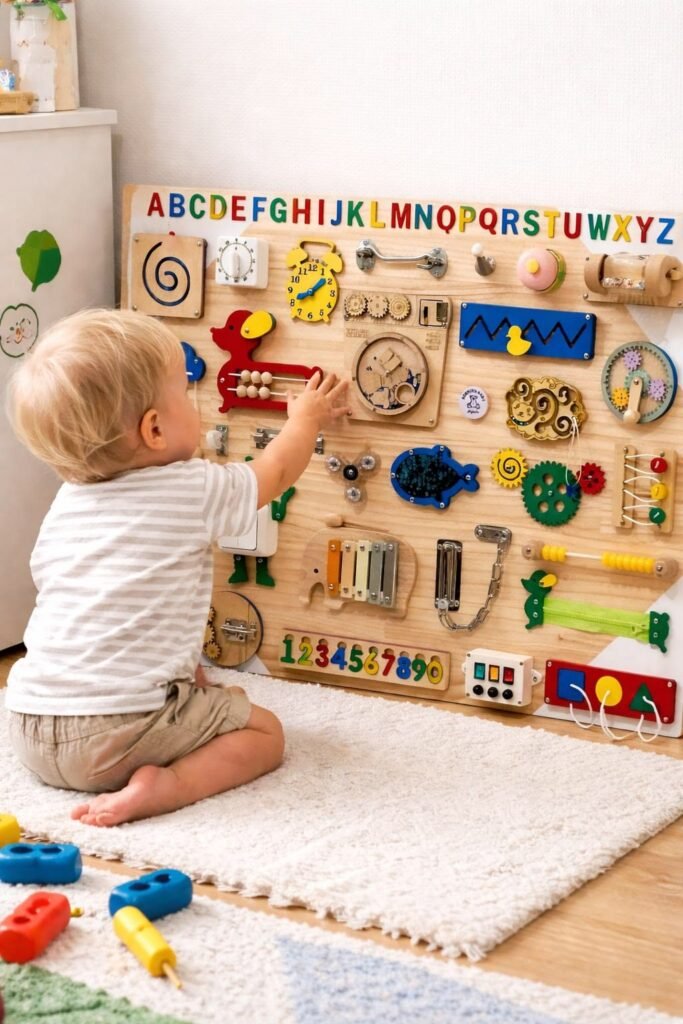
Choosing a kids wooden learning board in Pakistan can feel confusing. Shops and online pages show dozens of boards with colorful letters, numbers, and shapes, and most of them look similar in photos. Yet the quality, safety, and usefulness vary a lot. This guide explains what a wooden learning board is, which type fits your child’s age, what to check before you buy, and how to use it at home so your child actually enjoys it.
Nexora Mart is your trusted destination for Online Shopping in Pakistan, offering quality toys, home appliances, energy-saving fans, and everyday products at competitive prices.
What Is a Kids Wooden Learning Board?
A kids wooden learning board is a flat wooden panel designed to teach basic early skills through touch and play. Most have cut-out spaces where children fit in loose wooden pieces such as letters, numbers, animals, or shapes. Some boards use pegs, knobs, or magnetic pieces. Others are simple slates for tracing or writing practice.
The direct answer for most parents is this: a good wooden learning board is a smooth, sturdy, child-safe panel with pieces that fit snugly, matched to your child’s age and current skills. For a toddler, that usually means a simple puzzle-style board with big knobbed pieces. For a preschooler, it may be an alphabet or number board. For an older child, a tracing or counting board works better.
Wood is popular for good reasons. It is durable, it feels pleasant in small hands, and it handles rough use better than thin cardboard or brittle plastic. A well-made board can also be passed to a younger sibling.
Why Parents in Pakistan Choose Wooden Boards
Many families want learning tools that support Urdu and English together. A wooden board lets a child touch each letter while a parent says its sound or name. This slow, hands-on approach often holds a young child’s attention better than flipping through a book.
Wooden boards also work well in our climate and living conditions. They do not need batteries or charging, which helps during load shedding. They are quiet, so they suit small homes where several family members share space. And because the activity is physical, it gives children a break from screens, which many parents find hard to limit.
It is worth being honest about limits. A board will not teach a child to read by itself. It is a tool that works best when an adult sits nearby, names things, asks questions, and celebrates small wins.
Which Type of Wooden Learning Board Suits Which Age?
The right board depends on what your child can do now, not just their age on paper. Children develop at different speeds, so treat these ranges as rough guides.
Toddlers (around 1 to 2 years)
At this stage, children are learning to grasp, turn, and place objects. Look for a board with a few large pieces, each with a chunky knob or peg. Simple shapes, fruits, or animals work well. Avoid boards with tiny pieces. A toddler should not be able to fit any piece into their mouth.
Early preschoolers (around 2 to 4 years)
Children in this range enjoy matching and naming. Alphabet boards, number boards from one to ten, and shape-sorting boards fit well. Boards with a picture beneath each piece help children check their own answers, which builds confidence and independence.
Older preschoolers and early school age (around 4 to 7 years)
These children are ready for tracing boards, counting boards, clock-learning boards, and simple word-building sets. Urdu alphabet boards are also useful at this stage, especially if your child will start reading in both languages. A writing slate with grooves can help a child practice letter shapes before holding a pencil.
How to Choose a Safe, Good-Quality Board
Safety comes first because young children put things in their mouths. Start by checking the finish. Paint and varnish should be non-toxic and should not flake or rub off on your fingers. If a seller cannot tell you what finish was used, treat that as a warning sign. Be careful with strongly smelling boards, since a harsh chemical odor can suggest poor-quality coatings.
Next, run your hand over the edges and corners. They should be rounded and smooth with no splinters. Check the back of the board too, since rough or uneven wood there can scratch tables and small hands.
Shop a kids wooden learning board in Pakistan at Nexora Mart to make learning fun, interactive, and engaging for children.
Then look at the pieces. They should fit the cut-outs easily but not loosely. If a piece is too tight, your child will get frustrated. If it is too loose, the board loses its learning value because the child cannot feel a correct match. Pieces should also be large enough that they cannot be swallowed. As a general guide, anything that fits easily through a toilet paper roll is too small for a child under three.
Finally, think about weight and thickness. A board that is too thin may warp or crack over time, especially in hot, humid weather. A moderately thick board with solid construction usually lasts longer. Many boards sold in Pakistan use MDF or plywood rather than solid timber. These can be perfectly fine when well finished, but cheap versions may swell if they get wet, so keep them dry.
Common Mistakes Parents Make When Buying
One common mistake is buying a board that is too advanced. A parent sees a colorful board with fifty pieces and assumes more is better. In practice, a child who cannot complete it feels discouraged and loses interest. Starting simple and moving up works much better.
Another mistake is choosing by looks alone. Bright colors attract adults in the shop, but a board with a well-fitting design and clean finish is more useful than a flashy one with poor craftsmanship.
A third mistake is ignoring language needs. If you want your child to learn Urdu letters, check that the board actually includes them with correct, clear shapes. Look closely at spelling and letter forms, because errors do appear on cheaper products.
Finally, some parents buy several boards at once. Too many toys can scatter a child’s attention. Two or three well-chosen boards, rotated every week or two, often hold interest longer than a pile of options.
How to Use a Wooden Learning Board at Home
Short, relaxed sessions work best. Ten to fifteen minutes is plenty for a young child. Sit on the floor with them, hand them one piece at a time, and name it clearly. If your child is learning letters, say the sound as well as the name. Let them try to fit the piece themselves before you help.
Turn the board into small games. Hide a piece under a cushion and ask your child to find it. Ask them to bring you the red shape or the animal that makes a certain sound. These little challenges build vocabulary and listening skills without feeling like a lesson.
Here is a real-life scenario that many parents will recognize. A three-year-old keeps throwing the pieces of a number board across the room. Instead of scolding, the parent turns it into a game: each number must be carried to the board in a toy basket and counted aloud on the way. The child still moves around, but the energy now goes into learning. Small adjustments like this often solve behavior problems.
Praise effort rather than speed. If your child puts a piece in the wrong place, say, “Let’s try another spot,” instead of calling it wrong. This keeps learning pleasant and encourages them to keep trying.
Frequently Asked Questions
Are wooden learning boards better than plastic ones?
Neither is always better, but wood is usually sturdier and feels more natural in a child’s hands. Plastic can be lighter and cheaper. What matters most is non-toxic finish, smooth edges, and good construction, whatever the material.
At what age can I start using a wooden learning board?
Many children can start around the age of one with a very simple board that has a few large knobbed pieces. Always supervise young children, and choose boards without small parts that could be a choking risk.
How do I clean a wooden board safely?
Wipe it with a slightly damp, soft cloth and dry it right away. Avoid soaking it or using strong chemicals, since water can damage the wood and harsh cleaners can affect the paint. Let it dry fully before your child plays again.
Can a wooden board help my child learn to read and write?
It can support early skills such as letter recognition, counting, and hand control. It cannot replace reading together, talking, and practicing writing. Think of it as one helpful tool among several.
Your Next Step
A kids wooden learning board in Pakistan is worth buying when it matches your child’s age, uses a safe finish, and has well-fitting pieces. Start simple, supervise young children, and keep sessions short and playful. Before you buy, pick up the board if you can, check the edges, test the fit of a few pieces, and ask what finish was used. That quick inspection will tell you more than any product photo, and it will help you choose a board your child will actually enjoy using.