

Reverse swing is one of cricket’s most fascinating skills. A fast bowler, bowling with a ball that is 35 or 40 overs old, suddenly makes it swing late, fast, and in the opposite direction to what the batter expects. The batter sets up for an outswinger, and the ball curves in towards the stumps. That late movement, at a high pace, is why reverse swing has won Test matches and changed series.
The key idea is simple to state and hard to master. With a new ball, the ball swings in the direction of the seam. With a very old ball, where one side is rough and the other side is shiny, the ball can swing in the opposite direction, towards the shiny side. That is a reverse swing.
First, what is conventional swing?
To understand reverse swing, you need to understand conventional swing first. A new cricket ball has a proud seam running around the middle of the ball, with two hemispheres on either side. A bowler who holds the seam at an angle and bowls with the seam upright can make the ball swing in the air.
Here is how it works. Air flows over the ball as it travels towards the batter. On the side where the seam is angled towards the batter, the air is disturbed by the seam and becomes turbulent. On the smooth, shiny side, the air flows in a smooth, laminar layer. The turbulent air stays attached to the ball for longer, which creates lower pressure on that side, and the ball is pulled towards the seam side. In simple terms, a new ball swings towards the side the seam is pointing at.
Conventional swing works best with a new, hard ball at a good pace in humid or overcast conditions. It usually fades after 15 or 20 overs, as the ball softens and the seam flattens. That is when most fans think swing bowling is over for the innings. Reverse swing proves them wrong.
How Reverse Swing Works: Rough Side, Shiny Side, and Pace
Reverse swing needs three things: a ball old enough to have one very rough side, one side kept shiny, and enough pace from the bowler.
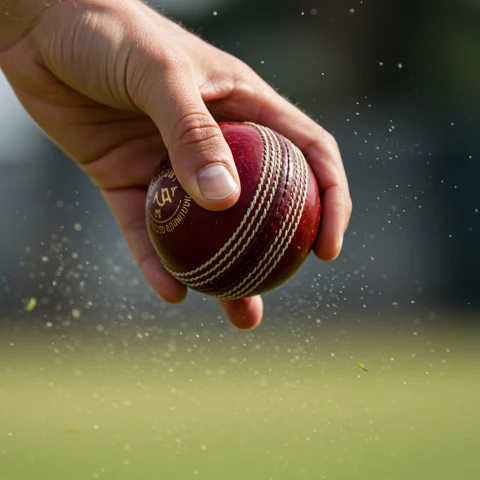
As a test innings goes on, the ball hits the pitch, the bat, and the outfield, over and over again. One side becomes rough and scuffed, while the fielding team works hard to keep the other side shiny by polishing it on their clothing and with sweat. After 30 or 40 overs, the difference between the two sides is extreme.
At this point, the physics changes. When the ball is bowled at a high pace, usually above 135 kilometres per hour, the air flow on the rough side becomes turbulent very early and then separates from the ball quickly. On the shiny side, the air stays smooth for longer. That creates lower pressure on the shiny side, and the ball is pulled towards the shiny side. In other words, the ball swings in the opposite direction to the conventional swing, even though the bowler is holding the seam in the same way.
That is why reverse swing is so deceptive. A batter who reads the seam position and expects a conventional swing will move the wrong way. The ball also swings late because the pressure difference only becomes strong when the ball is close to the batter at high speed. Late swing at 140 kilometres per hour leaves almost no time to adjust, which is why reverse swing produces so many bowled and leg-before-wicket dismissals.
Who Discovered Reverse Swing, and Who Mastered It?
Reverse swing was developed by Pakistan’s fast bowlers in the 1970s and 1980s. Sarfraz Nawaz is often credited with first using it systematically, and Imran Khan, Wasim Akram and Waqar Younis turned it into a weapon that changed Test cricket. Wasim and Waqar, bowling together in the 1990s, could make an old ball swing both ways at high pace, with yorkers that swung late into the batter’s toes.
Later bowlers have added their own versions. James Anderson of England mastered it in English conditions, using wrist position and control to swing the old ball both ways. In recent years, Jasprit Bumrah and Mohammed Shami of India have used it in Test cricket, especially on dry pitches, and Mitchell Starc of Australia has used it with his left-arm angle.
What all these bowlers share is pace, control, and wrist position. Reverse swing does not work at a medium pace, because the airflow needs speed to create the pressure difference. It also does not work if the seam wobbles in the air. The bowler must keep the seam steady, with the shiny side on the correct side, and bowl a full length so the ball has time to swing before it reaches the batter.
Why Reverse Swing Is Harder in White-Ball Cricket
Reverse swing is mainly a Test cricket weapon. In Test cricket, one ball is used for 80 overs, so it has time to become very rough on one side. In one-day internationals, two new balls are used, one from each end, so each ball is only 25 overs old at the end of the innings. In T20 cricket, the ball is only 20 overs old at most, which is not old enough for true reverse swing.
Dry pitches and dry outfields help reverse swing because they scuff the ball faster. That is why it is often seen in Pakistan, India, and Australia. Humidity helps conventional swing, but reverse swing is more about the condition of the ball and the pace of the bowler than about the weather.
Is Reverse Swing Legal?
Yes, reverse swing itself is completely legal. It is a skill, like spin bowling or a slower ball, and it comes from the natural wear of the ball during a match. What is illegal is ball tampering, which means deliberately altering the condition of the ball by scratching it, picking at the seam, or using an artificial substance to roughen one side.
The laws allow fielders to polish the ball, as long as they do not use artificial substances, and they allow the use of sweat to shine it. Saliva, once used to shine the ball, was banned by the ICC, with the ban made permanent in 2022. The ball-tampering scandal in Cape Town in 2018, when Australia’s Cameron Bancroft was caught using sandpaper, was illegal tampering, not reverse swing. Reverse swing is what happens when a ball wears naturally and a bowler uses it brilliantly. Tampering is cheating, and it is punished.
For fans following Test cricket through score apps and fan pages, Cribet99 is often mentioned as one companion source alongside official match coverage, but the best way to learn reverse swing is to watch a full spell with the old ball and to look at the seam position and the shiny side, not just at the scorecard.
Frequently Asked Questions
What is a reverse swing in simple terms?
When an old ball, with one rough side and one shiny side, swings towards the shiny side at a high pace, which is the opposite direction to a conventional swing with a new ball.
How old does the ball need to be for a reverse swing?
Usually 30 to 40 overs old in Test cricket, when one side has become very rough and the other side has been kept shiny.
How fast do you need to bowl for reverse swing?
Usually above 135 kilometres per hour. At lower speeds, the air flow does not create enough pressure difference between the two sides.
Who are the best reverse swing bowlers in history?
Wasim Akram and Waqar Younis of Pakistan, along with Sarfraz Nawaz and Imran Khan. Later masters include James Anderson, Jasprit Bumrah, Mohammed Shami and Mitchell Starc.
Is reverse swing the same as ball tampering?
No. Reverse swing comes from natural wear and legal shining. Ball tampering means deliberately damaging the ball, which is illegal and punished.

